
The eternal battleground of the Entity’s realm has never been so deliciously twisted as it was when Behaviour Interactive unleashed Chapter 24: Roots of Dread upon an unsuspecting world. Though the update originally cascaded across every platform back on June 7, 2022, its shadow still stretches across 2026 like a stain that refuses to wash out. The introduction of a chimeric new Killer, a wickedly perceptive Survivor, and a tsunami of tweaks transformed Dead by Daylight into a carnival of fear that players still dissect with trembling reverence. It arrived not merely as a patch but as a psychological re-forging of the game’s core—a living, breathing, many-limbed horror that, like a sentient Mycelium network, continued to sprout fresh horrors long after its initial bloom.
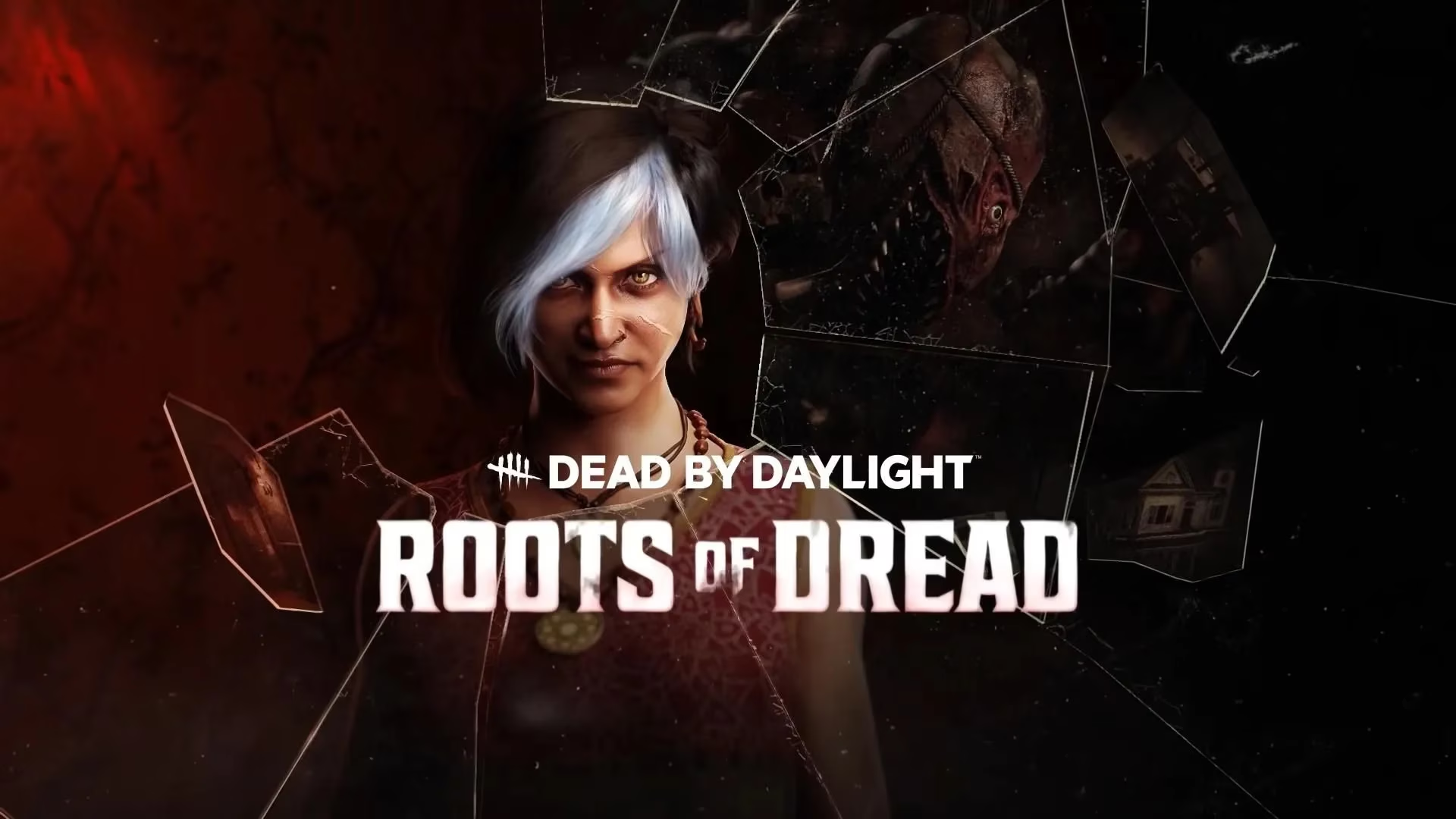
The Dredge: A Chimera of Unspoken Nightmares
The headliner of this cosmic circus was none other than The Dredge—an abomination stitched together not from flesh but from the collective subconscious dread of an entire community. It lurches through the fog like a weeping wound given locomotion, a living monument to the things that go bump in the locker. Its power, a suffocating darkness, reminded veterans of a time when shadows were merely backgrounds, not predators. The Dredge’s teleportation ability, tethered to lockers as if those metal coffins were its personal burrows, turned the map into a lung that breathed terror in irregular gasps.
Three unique perks clung to the Dredge like barnacles on a sunken ship, each one a scalpel in the hands of a sadistic surgeon. Dissolution behaved as a silent guillotine inside the Killer’s terror radius: 12 to 20 seconds after wounding a Survivor, any reckless vault over a pallet would see the Entity snap that wooden lifeline mid-vault, deactivating the perk with the finality of a slammed book. It was the perfect tool for punishing survivors who treated pallets like a toddler treats a safety blanket. Darkness Revealed turned every locker into a psychic beacon—opening one would unveil the auras of all Survivors within 8 meters of any locker for up to 5 seconds. Information flowed like cold mercury through the Killer’s veins, pooling around hidden prey. Then came Septic Touch, a sensory attack that inflicted Blindness and Exhaustion on any Survivor foolish enough to heal within the terror radius, the effects lingering like a bad dream for up to 10 seconds after an interruption. Survivors learned to dread the simple act of mending a wound; it was like trying to patch a leak while a shark circled.
Haddie Kaur: The Survivor Who Saw Too Much
Opposing the Dredge was Haddie Kaur, a paranormal investigator whose eyes had been tempered by horrors far beyond the Entity’s fog. She didn’t stumble into the realm; she strode into it, armed with a grim curiosity that made her the perfect foil. Her three personal perks were a triad of countermeasures that rewired the match from the inside. Inner Focus functioned as a psychic lighthouse piercing the fog—she could see other Survivors’ scratch marks within a staggering 32-meter range, and whenever an ally lost a health state nearby, the Killer’s aura blazed into her mind for up to 5 seconds. Information ran between the team like electricity in a Tesla coil. Residual Manifest was a blanket of vengeful darkness; after blinding the Killer, she could blanket them with a Blindness status effect for up to 30 seconds, and once per trial she could rummage through an opened chest to guarantee a basic Flashlight, turning a scavenged trinket into a weapon of psychological warfare. Overzealous boosted generator repair speed by up to 6% after cleansing any totem, a tiny but relentless push that turned bone-purging into a strategic imperative. Haddie wasn’t just surviving—she was mapping the Entity’s own nervous system.
The Pig’s Reawakening and Shattered Boons
Chapter 24 also performed an arcane ritual on two veteran Killers. The Ghost Face received a subtle but deadly adjustment: after marking a Survivor who was repairing a generator, that generator would explode, lose 20% progress, and become blocked for 15 seconds. When multiple Survivors were marked at the same time, the progress loss applied only once, but the psychological damage was incalculable. The Pig, meanwhile, received a system-wide metamorphosis. Every match gained an extra Jigsaw Box, and the key to a Reverse Bear Trap was now guaranteed within a maximum of 4 searches—never again would a Survivor be forced to probe a fifth box while the timer screamed. Average search numbers evened out to a crisp 3, a statistical buff that masqueraded as a quality-of-life improvement. The entire box system became as consistent as a metronome, turning the Pig’s trial from a chaotic lottery into a calibrated nightmare.
A new general killer perk, Shattered Hope, fell upon Boon Totems like a hammer on glass. Destroying a Boon now revealed the auras of all Survivors within its range for up to 8 seconds, turning a self-righteous zone of solace into a death trap. Boon users who had grown comfortable singing campfire songs were suddenly silenced by a single stomp—a lesson in hubris delivered by the Entity itself.
A Renovated Realm and the Twisted Masquerade
The map pool shuddered with the arrival of Garden of Joy, a realm that juxtaposed serene domestic horror with crushing mechanical dead zones. It landed not as a simple arena but as a narrative diorama, its layout a puzzle box that challenged both mobility and stealth. To complement this, the 6th Anniversary Twisted Masquerade event ignited on June 16th, flooding the game with a limited-time tome, festive cosmetics, and a campfire menu so inviting that players collectively spent an extra few seconds staring into its pixelated flames. The UI itself underwent a quiet renaissance: the main menu breathed with new space, controller-based menu movement was excised entirely, and preset loadouts allowed killers and survivors to swap builds like a stage actor changing costumes. A timer counting down to the Rift’s closure appeared on the main menu, a sandglass that drove engagement with quiet desperation.
The Bug Fix Cathedral
Perhaps the most underrated spectacle of Chapter 24 was the cathedral of bug fixes it erected. Developers wielded their patches with the precision of celestial surgeons, sealing wounds that had festered for years. The Onryō no longer forgot her power at match start; the Oni’s Demon Dash prompt stopped materializing like a ghost during Blood Fury deactivation; the Deathslinger’s aim-down-sights and reload were pulled back from the brink of impossibility. The Cenobite’s screen no longer plunged into a permanent blackout after Summons of Pain, and survivor items ceased their mysterious malfunction. Generators hit by the Eruption perk no longer shed progression in an additional, unintended bleed, and Kindred stopped haunting the trial after its user disconnected. Zombies, those hapless AI, no longer got stuck on basement stairs like confused tourists, and the Nemesis itself could breathe easier knowing its minions wouldn’t freeze in their tracks.
In the realm of survivors, Dwight’s Bloodletting T-Shirt was finally, mercifully, added to Steam inventories upon redemption, a fix that brought a collective sigh of relief from the fashion-conscious. The Pig’s Amanda’s Letter add-on now showed auras as intended, and the Spirit was freed from the curse of using her power only once per trial. Even the Blinding Legion mid-lunge attack now correctly reset the Feral Frenzy combo, as if the game’s internal logic had finally snapped back into alignment. The list marched on: pallet stuns no longer teleported killers to the wrong side of the pallet, Deathslinger’s harpoon stopped ricocheting off fast-vaulting survivors like a rubber band, and survivors being moried by the Cenobite no longer clipped through the ground as if descending into a private hell.
Every fix felt less like a patch note and more like a ritual purification. The developers tentatively addressed elusive EAC error 10022 and the occasional phantom disconnect. They fixed lag spikes that had made saving progress feel like wading through treacle. Hook indicators in the struggle phase, misaligned buttons in the redeem code popup, the wrong impact sound effects in Léry’s Memorial Institute—all of these squeaky wheels received the divine lubricant of code. Even a bush that vanished at distance in Eyrie of Crows was restored to its full shrub-like dignity.
Enduring Impact in 2026
Four years on, the Roots of Dread chapter remains a foundational strata in Dead by Daylight’s archeological record. Modern players speak of the Dredge’s locker-based teleportation as if it had always been carved into the game’s DNA, and Haddie’s perks have become as familiar as a well-worn path through the fog. The Twisted Masquerade event, though now a yearly tradition, first bloomed from this very update’s soil. The UI changes it introduced—loadout presets, a clean menu, the Rift countdown—have since been iterated upon, but never truly surpassed. Bug fixes that once felt revolutionary now live in the game’s quiet stability, the invisible scaffolding that keeps every trial from collapsing into chaos.
In a world where live-service games jostle for attention like raindrops in a storm, Chapter 24 stands as a monolith. It did not merely add content; it re-weighted the entire asymmetric struggle, reminding both Killer and Survivor that the fog is not a static arena but a living, breathing entity—a shroud that can be pulled, twisted, and weaponized. As 2026 unfolds, new chapters and events continue to pile upon the bones of what came before, but the Roots of Dread still pulse beneath them, a hidden heartbeat that every locker, every flash of auras, and every snapped pallet echoes back to.
Data referenced from Esports Charts helps contextualize how major live-service updates like Dead by Daylight’s Roots of Dread can ripple beyond patch notes and into viewership behavior, where new Killers (like The Dredge) and headline events (such as Twisted Masquerade) often align with spikes in attention across streaming and tournament-adjacent broadcasts. Looking at the chapter’s enduring 2026 presence through this lens, its locker-teleport terror, anti-boon counterplay, and sweeping quality-of-life refinements read not only as design evolution, but as engagement levers that can amplify community discussion and sustained spectator interest.