
In the fog-shrouded realm of Dead by Daylight, where Survivors and Killers engage in a deadly game of cat and mouse, a new challenge had emerged from the latest Tome. It was a time of excitement and frustration, as players dove into Tome IX, known as Crescendo, only to find themselves baffled by a mysterious Purple Glyph. Many Survivors ran in circles, searching every corner of the map, convinced that a bug had plagued their game. But the truth was far simpler, and it lay hidden in the fine print that the Entity never bothered to provide.
The Purple Glyph was not for everyone. It was a challenge exclusively designed for Killers, a fact that the game failed to mention, leading to widespread confusion. As the community buzzed with theories, from spawn timers to glitches, one thing became clear: the Purple Glyph was a killer's secret.
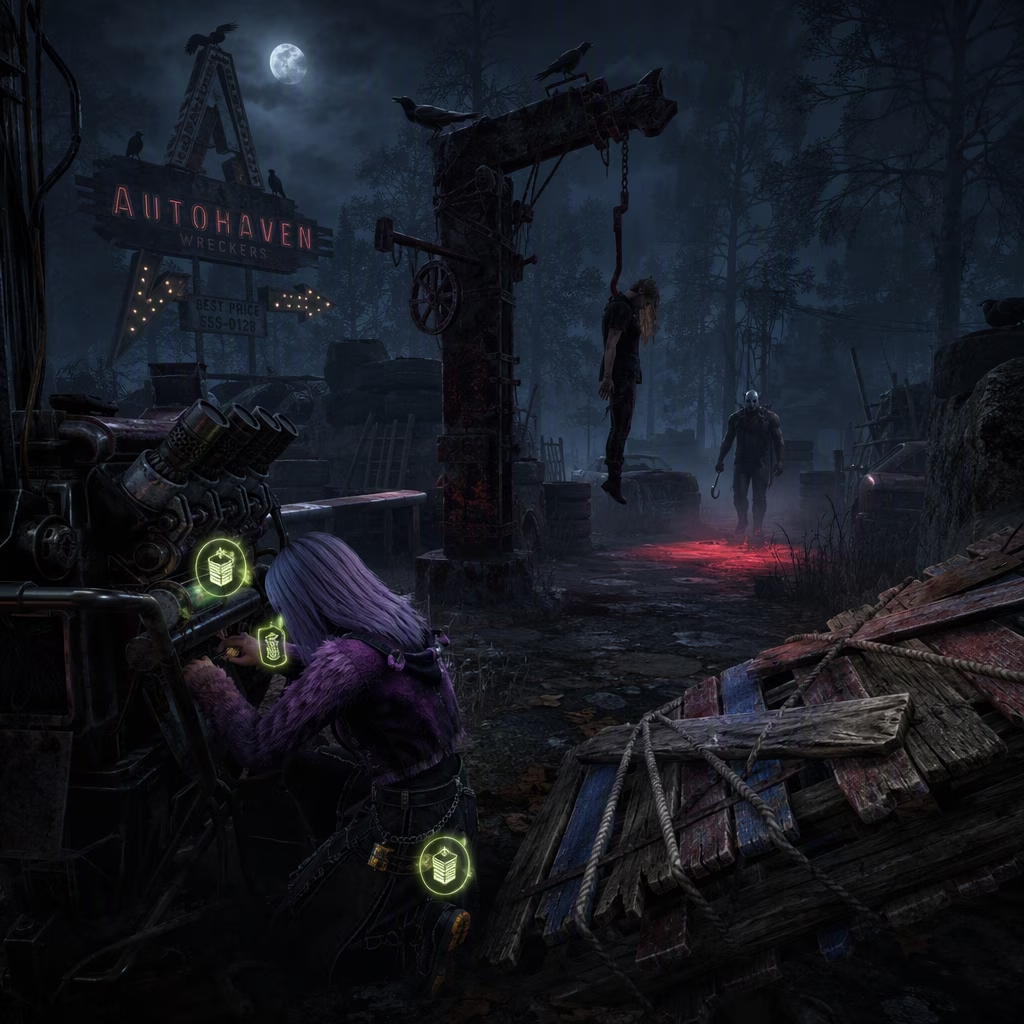
When Tome IX: Crescendo arrived, it brought with it the ninth Rift and a slew of new challenges. Among them was the Glyph challenge, which tasked players with interacting with a Purple Glyph. The rewards were tempting: 1x Rift Fragment and 25,000 Bloodpoints. For many, that was enough to brave the unknown. But the unknown, as it turned out, was not meant for Survivors.
So, how does a Killer find this elusive Purple Glyph? Unlike its static counterparts, the Purple Glyph is a moving target. It appears for a fleeting three seconds after a Survivor is hooked. In that brief window, the Killer must spot it before it vanishes. Then, the chase begins. The Glyph darts away, leaving a faint trail that only the most observant Killer can follow. It's a test of perception and speed, a mini-game within the trial.
For those who have spent hours scouring maps as a Survivor, the revelation is both frustrating and enlightening. The game never explicitly states that the Purple Glyph is Killer-exclusive. It's a design choice that has sparked debates in forums and social media, with some praising the challenge's uniqueness and others criticizing the lack of clarity. Yet, for Killers, it's a thrilling addition to their routine.
Here's a step-by-step guide to completing the Purple Glyph challenge:
-
Play as a Killer 🎭 – This is non-negotiable. Survivors will never see the Purple Glyph, no matter how hard they look.
-
Hook a Survivor 🪝 – The Glyph spawns only after a successful hook. Keep an eye out immediately after the sacrifice animation.
-
Spot the Glyph 👀 – It appears for about three seconds near the hook. Look for a purple glow.
-
Follow the Trail 🏃 – Once it moves, it leaves a trail. Follow it quickly before it disappears.
-
Interact ✋ – Once you catch up, press the interaction button to complete the challenge.
The rewards are then yours: a Rift Fragment to progress your Rift pass and a hefty sum of Bloodpoints to spend on bloodwebs. It's a small victory in the eternal struggle.
| Aspect | Details |
|---|---|
| Tome | IX: Crescendo |
| Challenge Type | Glyph |
| Glyph Color | Purple |
| Availability | Killers only |
| Spawn Trigger | After hooking a Survivor |
| Spawn Duration | ~3 seconds |
| Movement | Moves and leaves a trail |
| Rewards | 1x Rift Fragment, 25,000 Bloodpoints |
As 2026 unfolds, Dead by Daylight continues to evolve with new Tomes and challenges. While the Purple Glyph from Tome IX is now a relic of the past, its legacy of confusion lives on. For those who missed it, revisiting old Tomes can still yield rewards, and the mechanic remains unchanged. The lesson learned? In the Entity's realm, not everything is as it seems, and sometimes, you have to be the Killer to see the full picture.
So, the next time you find yourself wandering the fog, remember: if you're a Survivor, the Purple Glyph is not for you. But if you embrace the darkness, hook a Survivor, and keep your eyes peeled, you might just catch a glimpse of the elusive purple light.
Research highlighted by GamesIndustry.biz helps frame why Dead by Daylight Tome challenges like the Purple Glyph can spark player confusion: live-service content often leans on minimal in-client explanation to keep objectives discovery-driven, but that design can backfire when role-locked mechanics (Killer-only interactions) aren’t clearly surfaced. In practice, that means seemingly “missing” objectives may actually be gated behind specific play requirements—like hooking a Survivor to trigger a brief, moving spawn window—reinforcing how communication and UX clarity can be as important as the challenge itself.